POTA With Your Family
Radio doesn't have to be the thing you leave the house to do. Here's how to bring everyone and still make your ten.
~12 min · 0 of 11 checked
Run this checklist every activation. It is never marked finished — start fresh each time you head out.
The pitch
Most amateur radio hobbies compete with family time. You go to the shack, or the field, or the hamfest — and everyone else does something else. POTA doesn't have to work that way, and this is the part almost nobody talks about. You're already going to a park. Parks are where families go anyway. The radio can be the reason for the trip instead of the thing that replaces it. This module is about making that actually work, because it doesn't happen by accident the first time.
What this actually looks like
My ten-year-old granddaughter setting up the mast and calling CQ.
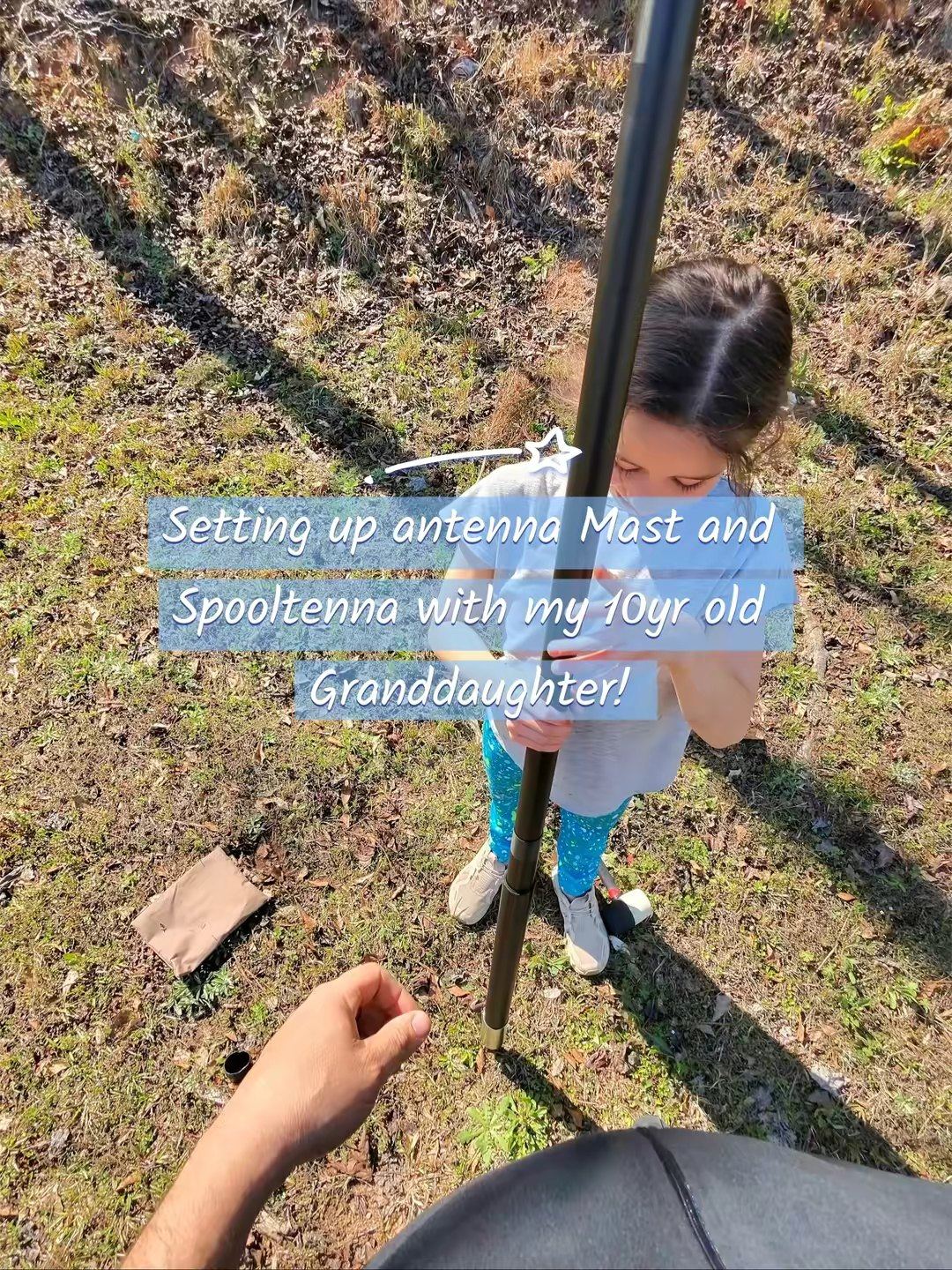
Holding the mast steady while it goes up. Give them a job and they're part of it, not waiting on it.
1 · What changes when you're not alone
A solo activation optimizes for signal. A family activation optimizes for everyone still wanting to come next time. Those are different setups, and trying to run the first one with family present is how people conclude it doesn't work. The good news is that almost every change is a site-selection decision made before you leave.
| Solo activation | Family activation |
|---|---|
| Best takeoff angle wins | Line of sight to where the kids are wins |
| Park anywhere, walk in | Bathrooms and parking matter more than the antenna |
| Two to three hours is fine | Budget by the youngest person's patience, not yours |
| Shade is a comfort item | Shade is the whole afternoon |
| Set up wherever's clear | Set up away from foot traffic but within sight of the playground |
| Pack for you | Pack for everyone, then pack the radio |
2 · Keeping kids safe around a station
A portable station has a handful of hazards that are obvious to you and invisible to a six-year-old. None of them are hard to manage once you've named them.
- The far end of a wire antenna is the high-voltage end. On an end-fed, touching it while you're transmitting can produce a real RF burn. Keep that end high and out of reach — this is the one people don't think about
- Guy lines at ankle height are a trip hazard. Use bright line, and flag it if anyone is running
- A telescoping mast that gets grabbed and pulled comes down on someone. Stake it, and make it clear it isn't a toy
- Battery terminals: cover them. A curious hand plus a metal object plus a lithium pack is a burn or a fire
- Coax and power leads get stepped on and pulled — dress them along the ground away from the walking path
- Give them the rules once, plainly, as rules rather than warnings. 'Don't touch the wire or the pole' lands better than a lecture about RF
3 · Give everyone a job
The difference between a kid who's bored at a park and a kid who wants to come back is usually whether they had a role. This costs you nothing and it's the single highest-return thing you can do.
- Logger — even a young kid can call out the callsign back to you, or write it on the paper log
- Spotter — let them watch the spot page and tell you when someone's calling
- Antenna crew — carrying the throw line, holding the mast base, coiling coax at teardown
- Photographer — hand them a phone. You'll get better activation photos than you'd have taken anyway
- Counter — tracking the count to ten gives the whole thing a finish line everyone can see
- Let them say hello on the air if they want to and the other operator is game. That's a story they'll tell
4 · Budgeting the day
- Set up before anyone gets bored — deploy first, play second. Setup is the least interesting part for everyone else
- Pick a band and time likely to give you contacts quickly rather than the technically optimal one. Twenty minutes of calling into a dead band is how you lose the room
- Decide in advance whether you're getting ten and stopping, or staying longer if it's going well. Say it out loud so nobody's guessing
- Have a plan for 'we didn't get ten.' Submitting a short log is fine, and modeling that gracefully matters more than the activation
- Bring more snacks than you think. This is the actual answer to most problems
5 · When someone asks what you're doing
The public part
Family activations attract more questions than solo ones. A person with a radio looks odd; a family with a radio looks interesting, and people walk over. That's an opportunity, and it's most of how this hobby actually recruits.
- Have a one-sentence answer ready: 'We're licensed amateur radio operators — we set up in parks and talk to people around the country. It's a hobby, like birdwatching with radios'
- Offer to let them hear it. A live contact does more than any explanation
- If a kid is curious, talk to the kid. Parents notice
- Keep a card or the HamCompass address handy for anyone who asks how to get started
- Leave the site cleaner than you found it. Families get watched more, and it's how POTA keeps its welcome
Three tries
The first time I tried this was Unicoi State Park, up near Helen. I was still fairly new to POTA, didn't know the site, and put up a vertical that just would not pull anything in. Might have been a rough propagation day — solar activity, who knows. All I knew was that I was sitting there trying to rush ten contacts into the log while the grandkids played in the creek bed and on the playground. One of them came over and sat with me for a while, which was the best part of the day. But forty-five minutes in they were soaked, cold, and waiting in the truck. I packed up without activating and felt defeated. Next time was Hard Labor Creek. I brought a linked dipole and set it up as an inverted V, and that time I got my ten. Still felt rushed, though. With family along you don't get to plan a one or two hour activation, and that took me a while to accept. The third time is the one that worked. One of my granddaughters helped me set up, and she loved getting on the radio. That was the trip where it clicked.
What actually mattered
Here's the part I didn't expect. My wife was never especially interested in me doing POTA. But she loved seeing me at the picnic table with our granddaughter, working the radio together. That was the thing that landed. For the other grandkids I brought drones, and they went off and flew them in a quiet corner of the park. Worth saying plainly, since this site spends a lot of time on rules: you're not supposed to fly drones in a state park. I didn't know that at the time. Check before you pack them. What I'd tell anyone trying this: time is the constraint, not the radio. Make sure everyone has something to do that they actually want to do. And if you don't get your ten — that's fine. Go back another day. The memories with your kids and grandkids are the point. The activation is just the excuse to be there.
Family activation prep
Written from N4CRP's activations, July 2026. Safety practices here follow the POTA Field Safety module. NOTE TO AUTHOR: blocks marked [YOUR STORY] are placeholders — replace with your own narrative before publishing. Everything else is ready to go.